Why write about northern Appalachia? What about its stories, characters, culture, questions, and landscapes inspire you?
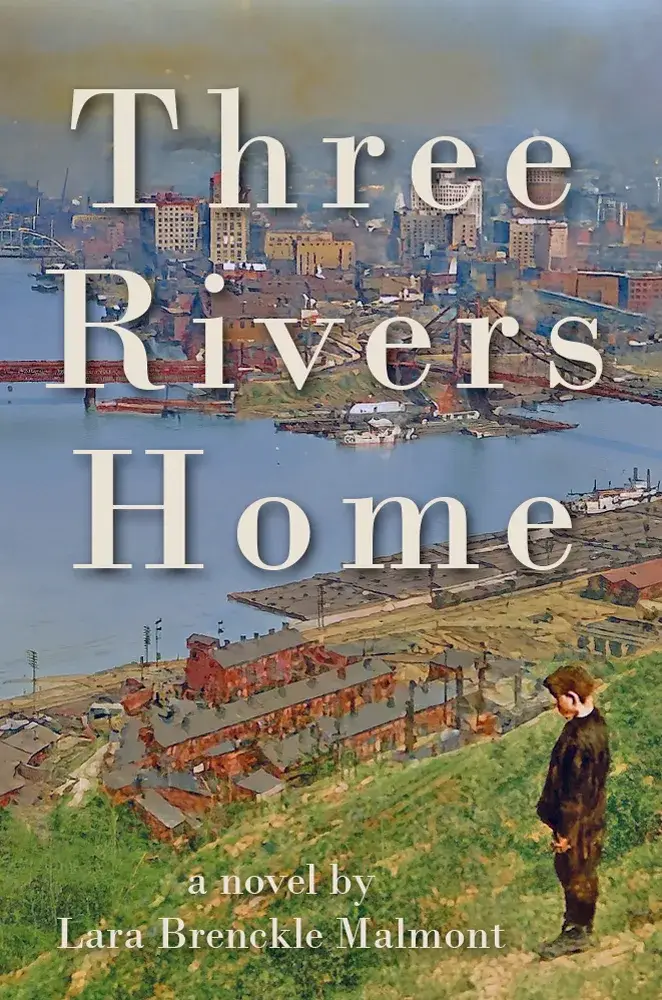
I write because I have missed Pittsburgh, and my grandfather, for my whole life. Though we never met, I realized we shared, a hundred years apart, a yearning for home and the way our hearts leapt when we returned. Even now, whenever the Squirrel Hill Tunnel’s darkness gives way to a bright May morning over the city, it takes my breath away. Whatever journey I’ve made is behind me, and I’m somewhere my soul settles differently. I’d wager many in northern Appalachia feel that way about the places they’re from. That’s what I tried to capture in Three Rivers Home.
The story is also about forgotten history, and it started with mine. In piecing together the broken branches of my family tree, I discovered a wider story that needed telling: Allegheny County’s policy of renting out its foster children for $5.60 a week, and what that choice did to children like my grandfather and great-uncle.
My grandfather’s story became Frankie Fortunato’s, and Frankie’s begins with a memory no one believes. Born during the 1907 flood, Frankie uses the tiny shells he finds in the dirt to prove he remembers the cataclysm, even when the adults say he’s being absurd and shush him. That tension, between kids who want to expose pain and elders who want to bury it, kept pulling me back.
I hope readers, watching a little boy lose everything thrice over (his parents, his relatives, and his hometown) and survive, find strength for their own hardest days.
What is the place of northern Appalachia writing in our country’s broader landscape of literature?
Northern Appalachian writing offers something many consider rare these days: a bridge between people who don’t see, or understand, each other’s lives. Multigenerational novels like Goshen Road and And It All Came Tumbling Down address working class lives that are neither New York skyline nor Tennessee holler, but a middle ground where home is a gravitational force.
Three Rivers Home adds to that body of work, revealing a pair of experiences rarely told together – the systemic abuse of “farming out,” or renting foster children for labor, and the Italian immigrant experience in Pittsburgh. These realities meet in the main character, Frankie Fortunato.
These books deserve more than a polite nod. They deserve readers, classrooms, and a place on the shelf alongside the Appalachia that people already know. In honoring the stories of families like the Fortunatos, we say that immigrants and foster children matter, as does the endurance of families who survived a thousand things that could have torn them apart.
How did you come to realize you were a writer?
In 4th grade, I got a D in English. Despite loving words, reading voraciously, and spending hours in my room imagining worlds, I couldn’t tell an adjective from an adverb. That was the same year I discovered a photo of my Grandpa Phil, the inspiration for Three Rivers Home’s main character, in my Grammy’s attic. I carried it home, never knowing that his story and a family built out of love and language would produce a novel.
The next year, my English teacher, Eleanor Pfeiffenberger (Mrs. P to her students), fed my enthusiasm with poetry and creative writing, and put me on the honor roll for the first time. “Take it and run with it,” she told me. In 8th grade, I moved to a new city, away from her guidance. In the midst of an ugly year, I wrote a poem about the beauty of a spring morning. The Cincinnati Public Library’s literary magazine, the Seven Hills Review, published it. In Cincinnati, on the Ohio River that begins in Pittsburgh, my name forever in black and white, I knew I was a writer. Later, I’d learn my grandpa stood on the banks of that same river, envisioning a future few thought possible. As our stories merged, his example kept my head up when things got tough, as did Mrs. P’s voice telling me run. I have been a writer all my life, but it took the grandpa I never met, and a caring teacher, to help me see it for myself.
What’s helped you succeed as a writer?
Three Rivers Home’s heart is found family, composed of those carried from birth and those whose care brought new life. It is the same for me. My husband, Jason, gave me uninterrupted writing time, rearranged his schedule while I attended conferences and seminars, and nudged the laptop across the sofa to ask, “Shouldn’t you be writing?” My mother, my first fan, read every version of this novel and also juggled her schedule to pick up my daughter, Jillian, so I could attend critique group. That set the table.
Joining Pennwriters laid out the banquet. Through their network, I found mentors, beta readers and a lovingly persistent critique group who kept me going through a global pandemic, rounds of rejection, and two near-catastrophic computer failures. When work situations put the book at risk, I found an employer who cheered me on.
Pennwriters also offered seminars on the craft, business and technicalities of novel writing, and led me to Lawrence Knorr and Sunbury Press Books. Sunbury’s professional editing and skilled marketing connected Three Rivers Home to a network of regional authors and editors, and to the northern Appalachian literary tradition.