How did northern Appalachia shape Harry Humes’s work? What do you see in his poetry that speaks particularly to the region’s landscapes, people, culture, and experiences?
Northern Appalachia served as the literal and emotional foundation of Harry Humes’s work. Growing up in Girardville, PA, in the shadow of anthracite coal mines, Humes was shaped by the dominating presence of an industry designed to strip the area of its natural resources, desecrate the area’s mountains and streams, and bring pain, dire health issues, and economic instability to those who lived there. While Humes wrote unflinchingly about the deleterious effects that the anthracite coal business had on northern Appalachia, he didn’t focus only on the area’s hardships. He also celebrated and lived his life in awe of the area’s lush natural world––with its abundant animals, birds, fish, trees, and wildflowers—that he first discovered as a child on the other side of those mountains. The breadth and depth of Humes’s commitment to representing northern Appalachia in his writing, as well as the panoramic view he provides for readers of the lives and world there, elevates him to a position as one of northern Appalachia’s most significant writers.
What place do you believe Harry Humes holds in the literary tradition of northern Appalachia? What does his work contribute to our understanding of the region and its place in American literature?
We put together a description of Humes’s work for the book’s website that addresses this pretty well, I think:
“Harry Humes carved out a unique place in American literature by chronicling Appalachian working-class life, natural landscapes, and disappearing rural traditions in Appalachian Pennsylvania with rare lyricism, humility, and precision. He wrote unflinchingly about the austerity and horrors of extraction as well as his deep connection with family and the area mountains and valleys not gutted by the anthracite coal industry.
This volume of Humes’s new and selected poems not only preserves the work of a significant American poet, offering scholars, teachers, and general readers a generous overview of the clarity, beauty, craft, and emotional depth of his substantial body of work. It allows future generations to rediscover poetry that deepens our understanding of how our labor, our landscapes, and our love shape us and change the ways we live and what we care about.”
What guided your decisions in assembling and editing Going Across the Water? What did you want readers to understand about Harry Humes and his work through this collection?
Thank you for that question. The book had a very long gestation period. Humes began work on something like a “selected poems” manuscript when he realized his first three books (Winter Weeds, Ridge Music, and The Way Winter Works) were out of print. He selected batches of poems from each book and compiled them into a manuscript.
I’m not sure if he ever followed through with submitting that manuscript anywhere, though. I think he got bored with the project and lost interest after a while. Humes’s interest was always the next poem, the next chapbook, the next book manuscript. He didn’t spend a lot of time patting himself on the back or reflecting on what he’d done. The son of a coal miner and a schoolteacher, he didn’t seek accolades. I always found that to be a greatly admirable trait of his. At the same time, though, I think his not putting out retrospective collections earlier in his career might have kept him from developing an even wider audience and getting his work the critical attention it deserves. I hope this book remedies that situation a bit.
So after around 1998 or so, there was no more talk of a selected or a new and selected manuscript. He kept publishing books and chapbooks and always had a manuscript going. It wasn’t until around 2010, while he was visiting Eastern Connecticut State University, where I teach, with another poet named Paul Martin, that the subject came up again. Martin brought it up. He encouraged Humes to put an extensive new and selected volume together because by that point he’d published more than 12 books. I agreed with Martin that the time felt right. Humes again didn’t express much interest. I think there might have been other factors at work then, not the least of which was a touch of self-doubt along with some health issues that he was beginning to have. Martin told Humes, “If you don’t want to do it, let Dan do it for you.” Humes liked that idea. Humes was like a second father to me. I was his student at Kutztown University in the early 1990s, and we’d maintained a close personal and professional relationship over the decades. Looking back, I don’t know why I didn’t think to ask him earlier. He looked me right in the eye and said “If you could do that for me, I’ll kiss your feet.”
I got to work on it and had a manuscript about 120 pages long that I shopped around to various poetry presses without much luck. There was a lot of interest in the book, but I soon came to learn that new and selected volumes are hard to get published because they are so expensive to produce. There are a lot of rights to obtain, and there are often substantial fees to obtain them.
It wasn’t until shortly after Humes’s death on April 4th, 2025, that a new path toward publication emerged for the volume. Another big fan of Humes’s work, Michael Garrigan, envisioned a manuscript of Humes’s work as a possible addition to Ohio University Press’s contemporary Appalachian literature catalog. That discussion lifted the book into a whole new realm. It was no longer just a matter of trying to find a home for the new and selected work of a great poet, it was offering Humes’s work as a substantial contribution to the field of contemporary Appalachian studies.
Ohio University Press was very interested and wanted to see the manuscript. That’s when the real fun part began for me. The press was open to publishing a substantial volume of Humes’s poems, not just a slim volume that other presses might have considered. The manuscript tripled from its first draft. I was able to increase my selections from Humes’s books and then dive into the treasure trove of unpublished and uncollected poems that I believe only I have. I had unpublished book manuscripts of Humes’s—one a full-length book, the other a chapbook. I had folders of poems that he gave me, as well as others his wife Nancy gave me. I had poems I found over the years in journals and online that I kept in a file folder, and I had three decades of letters we exchanged almost every week. In almost every one of those letters were two or three new poems, many of which were never printed anywhere. It was an honor and a joy to take that deep dive into all of the poems Humes wrote throughout his life and put this book together.
There are three essays about Humes’s work in the book (one by me), an extensive bio note that I put together chronicling his writing career, and an in-depth interview with Humes about his relationship with writing and the coal region.
I think he’d be deeply pleased by the book. I hope that he would allow himself to lean back in that chair in his writing room or in his usual spot on his back porch and allow himself to appreciate what an important contribution he made to American literature.
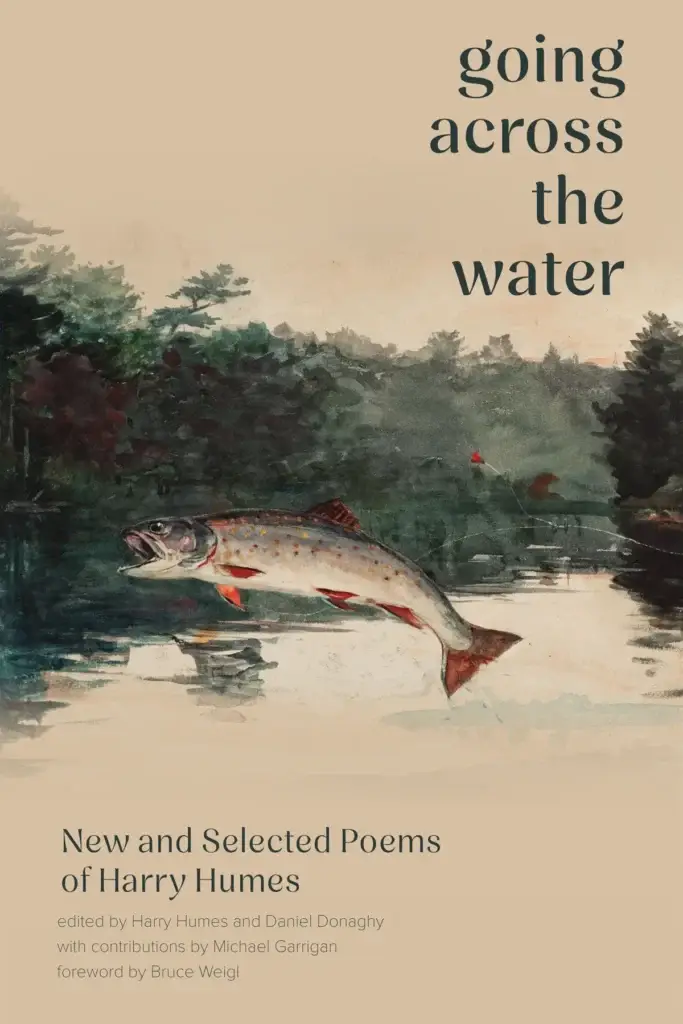
By the way, the title Going Across the Water was Humes’s idea. He had written it on a Post-it inside a Manila folder. It simply said: “Going Across the Water—new and selected title.” We had discussed other people’s new and selected volumes, and I recall him saying that if he ever had one, he wanted a title that suggested a metaphor of a long journey. For example, I remember him saying how much he loved the title of Gibbons Ruark new and selected, Passing Through Customs. I think Humes’s title evokes similar connotations. And it alludes directly to water, where he loved to spend so much of his time fly fishing in the rivers and streams of northern Appalachia.
Once Ohio University Press expressed interest in a much larger, comprehensive volume, I felt like I could finally include a more thorough representation of his work. Still, even though the book is 354 pages long, there are more poems that I wish were in there. I urge anyone who finds the book and falls in love with the poems in it to find Humes’s other books, too. There are so many gems in every one of his collections.
What do you hope Harry Humes’s literary legacy will be? What should future generations of writers and readers discover, remember, or learn from his poetry?
My answer to question #2 addresses this question as well, I think. I would also like to add that assembling the book made me appreciate the depth Humes’s reaches in his explorations of the natural world and of his experiences growing up in northern Appalachia in the anthracite coal region of Pennsylvania.
He writes with such clarity, empathy, and humility. I’d always known that about Humes’s work, but I developed an even deeper appreciation of it when I brought together poems from all his books with the scores of poems that he’d never published, every one of which is terrific. This book gives fans of Humes’s work a chance to experience it more fully and deeply than they ever had before. And it offers new readers a journey through northern Appalachia’s fields, rivers, towns, houses, and families, and a long and generous look inside a well-lived life.