Why edit books about northern Appalachia? What about its stories, characters, culture, questions, and landscapes inspires you?
I've always had a love for Pennsylvania. As a kid, there was nothing better than playing in the woods and creek near my house in rural Montour County on land that my great-grandfather once farmed and that my mother and her siblings grew up on. As a six-year-old, I marveled at a picture in my Compton's Encyclopedia of the confluence of the Susquehanna River. I took this as verification that I lived in a special place.
From the ages of 9 to 16, I lived in Florida. I was unhappy to leave PA, and extremely happy when my family moved back. The whole time I lived in Florida, I felt like I was in exile. While I learned to adapt and even enjoyed some parts of Florida life, I always felt that I was away from home.
As an adult, making my way in the world sometimes far from the Keystone State, I would occasionally run into people from rural Pennsylvania. We always hit it off, talking about PA and reminiscing about the landscape and activities like hiking and fishing.
Another one of the things I like about rural PA culture is how easy it is to talk to strangers. Years ago, my then fiancé wondered who the man was I talked with outside a department store for ten minutes. A New Englander with that region's reserve, she was astonished when I said I did not know the man, we just started chatting to pass the time and had enough small-town things in common to keep the conversation going until the man's wife returned from her errands.
I also like knowing that rural PA has a long and interesting history. As school kids we had tours of the Fort Augusta Museum and learned about the French and Indian War, about Chief Shikellamy and Conrad Weiser, a Moravian who allied with local native people. And about Joseph Priestly, the English scientist and theologian who sought religious freedom along the banks of the Susquehanna on the advice of his friend Ben Franklin.
I liked to hear stories and read about the region's industrial heritage of logging, railroads, and anthracite mining. When I was old enough to drive, I would go visit places like the small coal mining museum in Shamokin staffed by a former miner who was patient with a teenager who had endless questions.
I liked the family stories, too, like how my great-grandfather hauled produce to sell in town by horse and wagon during the Great Depression. And how often, hidden under a tarp or hay, would be jugs of moonshine for select customers. German (and English) speakers, my great-grandparents were still alive when I was small and I remember them fairly well. I always thought they were recent immigrants because of their use of German.
It wasn't until recent years that I found my great-grandfather's great-grandfather came to PA in 1731 and swore an oath to Pennsylvania. Perhaps I am still upholding that oath.
What is the place of northern Appalachian writing in our country's broader landscape of literature?
To me, much of American writing is regional writing: Faulkner's Mississippi, John Cheever's suburban New York, Junot Diaz's northern New Jersey. The beauty of America is its diversity and our literature reflects that.
I recently taught A Childhood by Harry Crews, considered by several reviewers to be among the best memoirs ever written. Crews writes about his early life in the 1930s in Bacon County, a place he calls the "rickets and hookworm belt" of south Georgia. It is a great book, and it transported my students to a place far removed from their own in terms of distance and especially time. That book has put out-of-the-way Bacon County on the literary map. The best books by writers from Northern Appalachia can do the same.
We need to claim writers as our own. Do people talk about graphic novelist Alison Bethel, author of Fun Home set in Clinton County, as a Northern Appalachian. Or Bedford County native and award-winning novelist David Bradley? His book The Chaneysville Incident, besides being an engaging book, provides a lot of history of western PA.
We also need to help raise up poets and writers from the region. I think we are doing that more and more through reading series that tout local authors, through regional literary conferences, and through journals and anthologies that focus on our region.
How did you come to realize you are an editor?
I learned to read when I was five, before I started school. As an only child living in the country, started to read a lot. Eventually I wanted to write things of my own. In first grade, I wrote a poem about my dogs that was published in the mimeographed school paper of my elementary school. I have not stopped writing since.
What has helped you succeed as an editor?
I learned to read when I was five, before I started school. As an only child living in the country, I started to read a lot. Eventually, I wanted to write things of my own. In first grade, I wrote a poem about my dogs that was published in the mimeographed school paper of my elementary school. I have not stopped writing since.
What's helped you succeed as a writer?
Being a reader is probably foremost. I have loved reading since I first learned to read. I also loved to discover new (to me) authors. If I found a book I liked, I would often read all others I could find by that person.
Likely just as important was advice and encouragement I got from teachers ranging from Mrs. Leib in elementary school who encouraged my poetry writing to Pulitzer-winner James Tate in graduate school really liking a poem I'd worked hard on after a few weeks of so-so writing.
WCoNA is working to establish a canon of northern Appalachian literature. What do you think that should look like?
Creating a canon seems like a difficult task. Perhaps it is because ideally it should be always adapting.
Will the next Junot Diaz come out of Hazleton or Wilkes-Barre, places with large and still growing Dominican populations? What northern Appalachia story would that author tell? And how do we decide?
Should be include Bedford-native David Bradley's The Chaneysville Incident, a brilliant book with dated references and metaphors that today's readers might not understand? Do we include Bradley's book and John O'Hara's works, though they are not read that much anymore.
My inclination is to be as inclusive as possible. If a work has a level of literary merit (not necessarily Pulitzer level) and contributes to a dialogue about Northern Appalachia, then that is good enough for me.
In addition to WCoNA, working with places like The Pennsylvania Center for the Book and other organizations might be a good way to disseminate and celebrate northern Appalachian authors individually and collectively.
Providing access to a website with a suggested canon, and perhaps seeking input from librarians, scholars, and teachers might be a way to engage a wide network who would be inclined to promote regional literature.
How do you approach your art and craft in a way that honors the region's complexities and its unique characters, places, dialects, etc?
For me, it is important to acknowledge the diversity within Northern Appalachia.
As a university teacher, I tell my students that I speak Central Pennsylvania English. There are words and phrases that are distinct to the region centered around the confluence of the branches of the Susquehanna River. Because I've been to lots of places in the state, I can mention the Johnstown "yinz," which is different from its Pittsburgh cousin. Or discuss the "Ho Butt" dialect of the anthracite region, something that is making a point-of-pride resurgence among a younger generation.It is important that I acknowledge, and want my students to acknowledge, the many ways Pennsylvanians speak and perhaps even understand the world.
I try to share the importance of our region with my students and others. I talk about John O'Hara's "Gibbsville," a stand-in for Pottsville in the heyday of anthracite mining, or the complex history of Bedford County, of people both Black and White, in David Bradley's The Chaneysville Incident. Alison Bechdel's wonderful graphic memoir Fun Home reveals how complex lives can be, even in a tiny town just over the mountain from the highway.
Books like these tell individual tales, but they can also map the social history of a region, explain their world in a way that can help us see our own more clearly.
In a way that is what I try to do with my poetry collections. Artemas & Ark details the lives of two people who might otherwise remain largely unseen in a town that probably matters little to those outside its borders.
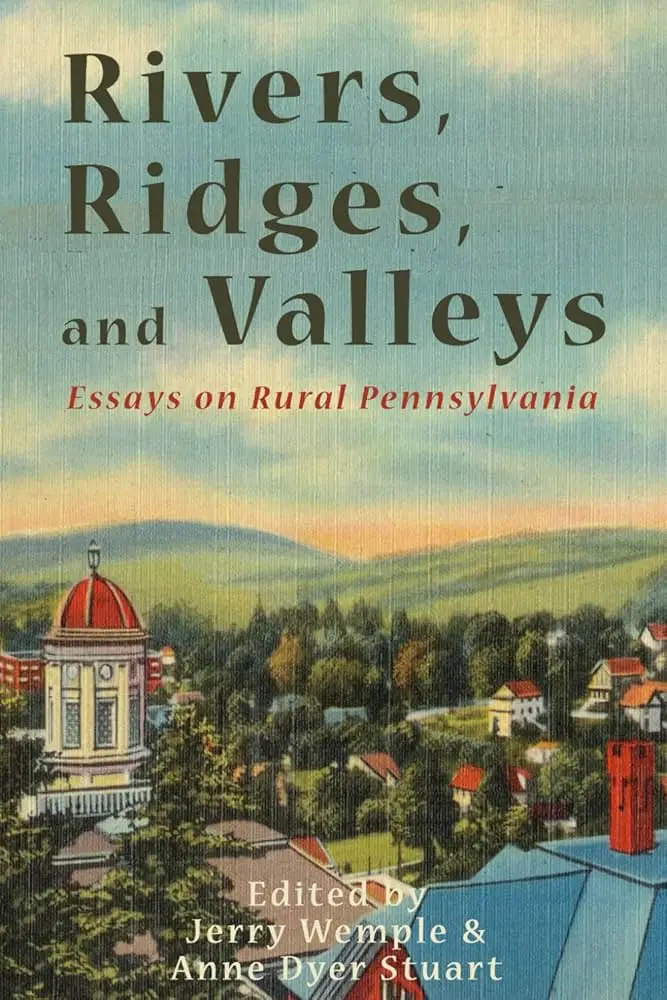
In the anthology Rivers, Ridges, and Valleys, I, along with my co-editor, wanted to collect essays that gave a platform to many Pennsylvanians and many views and experiences. A year after publication, I still enjoy re-reading these essays; each one provides a unique insight and sparkle.
How does the spirit and essence of northern Appalachia inspire your editing? And this book specifically?
Place, especially the Ridge and Valley region of Pennsylvania, has always been important to my writing. I've not always lived in rural Pennsylvania, but I always thought of it as my home.
I was never happier than when I moved back to Pennsylvania at age 16 after living several years in Florida. I bought an old car and a camera and would take drives to go hiking and look for places to photograph. That idea of capturing images made its way into my poems.
This anthology grew out of my own love of rural Pennsylvania and wanting to see what others had to say. Eventually I collected 27 essays that represent a wonderful mix of ideas and approaches. There are essays that ask us to appreciate nature and essays that remind us what happens to the landscape when we don't. There are essays by people who have come here from other states and from other countries, who realize that they, too, are now Pennsylvanians. And, of course, there are essays by Pennsylvania's native-born who tell the stories of generations, of what the past was like, and what it means to us now.
Rural Pennsylvania, and Northern Appalachia, is not one story but many. How we learn to appreciate each other is what can bind us together.